
Founder's Mindset
Customer Acquisition Marketing: 3 Ways to Grow a Business
Published Updated

What is customer acquisition marketing? Learn Jay Abraham's 3 ways to grow a business, plus 7 steps to get more customers and improve your marketing strategy.
Contents
- Three Ways to Grow a Business: Jay Abraham's Framework
- Why Customer Acquisition Comes First
- How to Get More Customers: 7 Acquisition Steps
- Marketing a New Product: Build the List Before You Launch
- Keeping New Customers: Repeat Purchases and Order Value
- How to Improve Your Marketing Strategy: 3 Questions to Ask
- Connect All Three Methods With X Lead
- FAQ
Customer acquisition marketing is the set of tactics — content, ads, social media and incentives — that turns strangers into leads who share their contact details, and then into paying customers. Marketing strategist Jay Abraham argues there are only three ways to grow a business: get more customers, get them to buy more often, and increase the value of each sale. Acquisition covers the first, and it's the starting point for the other two.
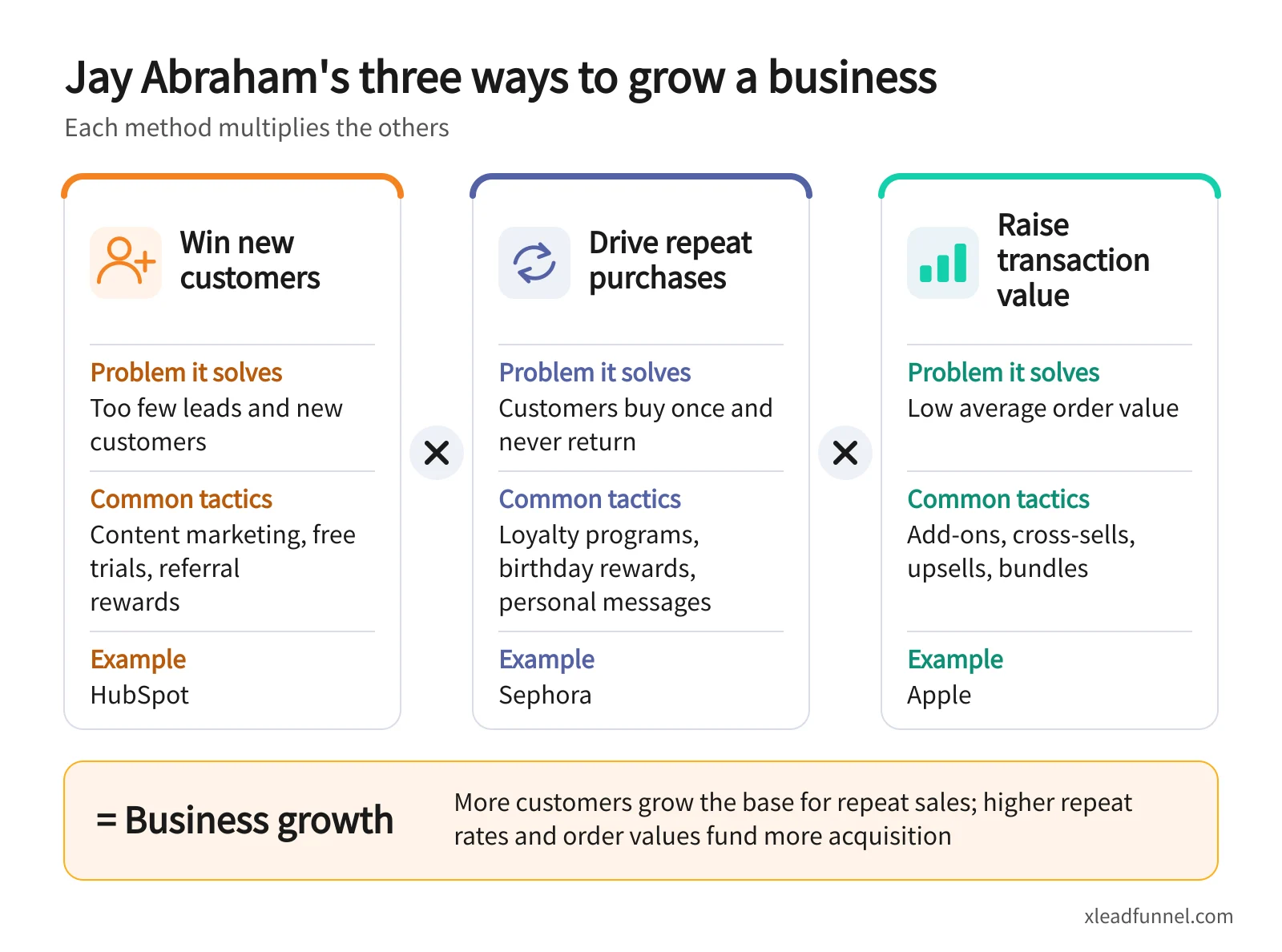
Three Ways to Grow a Business: Jay Abraham's Framework
Jay Abraham is a well-known American marketing strategist who has spent decades helping companies and individuals unlock their business potential and profitability. He advocates connecting every marketing activity so each one reinforces the others — building a predictable, measurable marketing system instead of trying tactics at random.
Jay Abraham once said there are only three ways to grow a business:
Win new customers; get customers to buy again; increase the transaction value
The three methods multiply each other: more new customers means a bigger base for repeat purchases, and higher repeat rates and order values give you more budget to spend on acquisition.
Why Customer Acquisition Comes First
Without new customers coming in, your customer base shrinks over time no matter how loyal or high-spending existing customers are. But acquisition has a classic trap: confusing traffic with customers. Someone seeing your ad or website doesn't mean they'll buy. Interest today fades by tomorrow, and a visitor who leaves without sharing contact details is very hard to find again.
So effective acquisition marketing does two things: attracts the right people, and turns them into a lead you can contact again at the moment their interest peaks.
How to Get More Customers: 7 Acquisition Steps
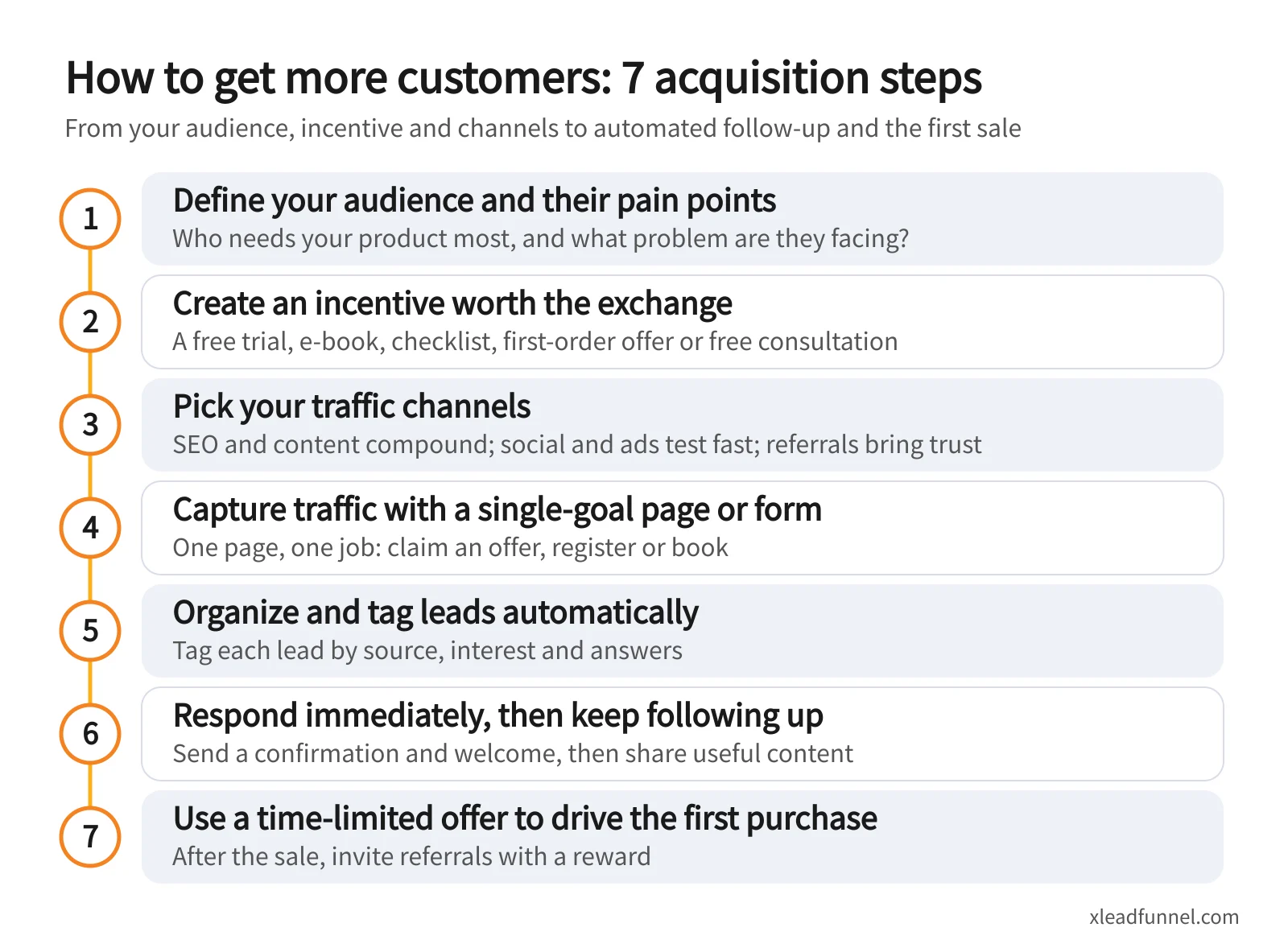
- Define your audience and their pain points. Be clear about who needs your product most and what problem is keeping them up at night. The sharper this is, the more precise your content and ads become.
- Create an incentive worth the exchange. A free trial, e-book, checklist, first-order offer or free consultation gives people a reason to share their contact details.
- Pick your traffic channels. SEO and content marketing compound over time; social and paid ads let you test quickly; partnerships and referrals bring in new customers who arrive with more trust.
- Capture traffic with a single-goal page or form. One page, one job — claim an offer, register for an event or book a consultation — so visitors don't get distracted and leave.
- Organize and tag leads automatically. Tag each lead by source, interest and answers so you can say different things to different people later.
- Respond immediately, then keep following up. Send a confirmation and welcome message the moment someone signs up, then share useful content on a steady rhythm so they come to see you as an authority.
- Use a time-limited offer to drive the first purchase. Once trust is built, a deadline creates urgency. After the sale, invite customers to refer friends and family with a referral reward.
Example: HubSpot's content-led acquisition
HubSpot, the U.S.-listed software company, offers a wealth of free digital marketing resources — blog posts, e-books and webinars — that help prospects solve problems while establishing the brand's expertise. Free tools, trials and premium content serve as the hook for visitors to register, email marketing deepens the relationship, and a well-timed offer converts leads into sales. It's the seven steps above in action.
Marketing a New Product: Build the List Before You Launch
The worst launch day is one where nobody knows you're launching. Instead of looking for customers after release, start acquiring them early:
- Let fans vote. Ask customers to vote on a new flavour or design. Voters care about the result and become the first people to hear when it launches. See the voting form.
- Survey real needs. Before settling on pricing or packaging, ask a few questions. Everyone who leaves contact details becomes a lead you can follow up.
- Open an early-access list. Trade an early-bird offer for contact details, then notify everyone on launch day.
Keeping New Customers: Repeat Purchases and Order Value
Once customers are in, the other two methods decide how much value each one brings.
Drive repeat purchases. Loyalty programs are among the most effective tools. Cosmetics retailer Sephora's Beauty Insider program lets members earn points on purchases and redeem them for products or offers, while member-only discounts, birthday gifts and early access to new launches keep customers coming back.
Raise transaction value. Offer add-ons (order bumps), cross-sells, and upsells or downsells at checkout. When customers buy a phone or laptop, Apple suggests a higher-spec model or more storage and recommends AppleCare+ and accessories — a textbook example. Related reading: "4 Keys to Guiding Customers Up the Value Ladder."
How to Improve Your Marketing Strategy: 3 Questions to Ask
- Is your traffic turning into leads? If visitors from ads or social media leave no contact details, the problem is how you capture them, not how much traffic you have.
- Are your leads being followed up? Leads sitting untouched in a spreadsheet mean wasted acquisition spend.
- Are past buyers invited back? Without repeat-purchase and add-on mechanisms, every new customer contributes just one transaction.
These three questions map directly to Abraham's three methods. Fixing your weakest link first usually beats trying every new tactic at once.
Connect All Three Methods With X Lead
- Win new customers: Lead forms cover seven purposes — enquiries, booking, redemption offers, event sign-up, surveys, voting and a mini store. Each form gets its own link and QR code to share on social media, in ads or in-store.
- Follow up and drive repeat business: Leads are categorized and tagged the moment they submit, then connect to automated messaging over EDM, SMS, LINE and WhatsApp to follow up on a rhythm and re-engage quiet contacts.
- The full journey: From acquisition and retention to nurturing and advocacy, the X Lead growth platform gives you a tool for every stage.
Ready to start building a customer list of your own? Sign up free and your first lead form can be live today.
FAQ
What's the difference between customer acquisition marketing and brand marketing?
Brand marketing makes more people aware of and remember your brand. Acquisition marketing turns the people who know you into leads you can follow up and, eventually, paying customers. They support each other, but acquisition results are easier to measure directly through lead volume and conversion rate.
How can a small business or solopreneur get more new customers?
Start with one clear incentive and one simple form — a free consultation booking or a first-order offer — and put the link on your social profiles and digital name card. On a tight budget, referral rewards are also a low-cost way to acquire customers. See more ideas for solopreneurs.
Can I increase new customers without raising my ad budget?
Yes. First check whether your existing traffic is converting into leads, then build organic traffic through content marketing, SEO and referral rewards. Improving the conversion rate of traffic you already have is often more cost-effective than simply spending more on ads.
Which metrics should I track for customer acquisition?
Common metrics include new leads, the lead-to-customer conversion rate, customer acquisition cost (CAC) and customer lifetime value (LTV). When lifetime value clearly exceeds acquisition cost, your acquisition strategy is ready to scale.
Related articles
- Why Personal Branding Matters So Much in the Gig Economy
- How to Choose Marketing Automation Tools for a Small Business
- [Must Read 2026] LINE Official Account Price Hike: Cut Costs