
Funnel Marketing
Landing Pages — How They Differ From Websites and Shopping Carts
Published
How do landing pages differ from websites and shopping carts? Compare goals, traffic sources, build time and cost, and see why a focused sales funnel converts better for flagship products.
Contents
- Why a landing page, and not a website or online store?
- How is a landing page different from a website?
- Shopping carts: an extension of the website
- Sales funnels: keeping visitors focused on the order
- Website, shopping cart or sales funnel: how do time and cost compare?
- Besides sales funnels, what other funnels are there?
Landing pages, websites and shopping carts differ in one thing above all: their goal. A landing page is built for a single action, a website is your company's information hub, and a shopping cart is the store feature that lets a website carry lots of products. If you're still unsure what a landing page is, or how it compares with Google Forms, start with What Is a Landing Page? Landing Pages vs Google Forms. This article tackles a different question: when you want to promote a product or collect leads, should you use a landing page, or build a website or online store?

Why a landing page, and not a website or online store?
From a funnel perspective, a landing page is goal-driven, simple and free of distracting links, and it has only one purpose: to get visitors to leave their details so you reach the goal you've set. It's lightweight, usually built around one prominent Call-To-Action (CTA) button, and it deliberately discourages visitors from wandering off.
A website, by contrast, can be as simple as a few pages about your company, or as complex as a system handling content management (CMS), bookings, memberships, online courses, events and e-commerce all at once. A website is your company's information hub.
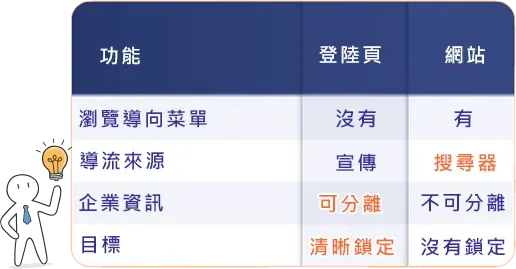
How is a landing page different from a website?
- Navigation: a landing page has no navigation menu; a website does, usually with a site map too.
- Traffic sources: a landing page gets its traffic mainly from ads or targeted social media shares; a website draws visitors from everywhere, including search engines.
- Relationship to company information: a landing page stands apart from your main website; a website carries your company information and the full range of products and services.
- Goal: a landing page has one goal — a CTA that drives sign-ups or purchases; a website lets customers explore your business from every angle, with no locked-in path to a specific action.
Shopping carts: an extension of the website
A website is anything customers can browse to look around online and get to know your business, and its features vary enormously — a shopping cart system being one of the most common. An online store can hold unlimited products across a handful to dozens of categories. It records orders and often includes a membership system so customers can come back and reorder.
You've probably been there yourself: the store is packed with products, you start browsing and ten minutes disappear, or you slip away to compare prices on another site selling the same thing — and never come back to buy.
Sales funnels: keeping visitors focused on the order
A sales funnel is one type of marketing funnel, and an effective way to guide people toward a purchase. Its landing page usually features just 1–2 products (though you can, of course, build in an add-on flow), so visitors see the flagship product you most want to promote at a glance, with no unnecessary information. You put the most compelling part up front, customers order with one tap and fill in only the essentials to pay, and a limited-time offer adds a "too good to miss" feeling. From arrival to purchase can take less than 3 minutes — an automated marketing machine.

Because it doesn't display a wall of products the way a shopping cart does, visitors don't wander in every direction and spend ages without ever hitting "Checkout". In practice, a website's overall design often slows customers down before they buy. To dig into why shoppers leave before checkout and how to bring them back, see Abandoned Cart Remarketing.
A funnel landing page exists to keep visitors focused on the call to action you've set, turning them from visitors into customers (Visitor to Customer). It also records the Customer Journey — the trail each visitor leaves — so you can remarket to them strategically later.
Website, shopping cart or sales funnel: how do time and cost compare?
Building an e-commerce site requires engineers to set it up and tune its performance. From a cost-benefit standpoint, unless you have so many products or so much information that only a large website will do, a funnel is an excellent conversion tool. More precisely, even if you already have a full website, a funnel is still your pipeline for driving traffic and converting it.
Economically, a small outlay buys you a "salesperson" that follows up with customers strategically: staying in touch automatically so you keep awareness, delivering useful information (nurturing), and gradually turning people into paying customers.
Besides sales funnels, what other funnels are there?
Funnels come in different types, depending on the goal you want to reach:
- Lead Funnels, for quickly capturing prospect details
- Event Funnels, for one-tap event registration
- Course Funnels, for creating passive income
- Survey Funnels, for gathering customer feedback
- Appointment Funnels, for securing a prospect's time slot
- Redemption Funnels, for driving O2O business
- Competition Funnels, for engaging your market
Every one of these starts with a focused page and a form. If you'd like to begin with one, browse the lead form overview and pick a registration, booking, redemption or survey form by goal — or, to sell straight from one page, see the mini store form.
Related articles
- Event Registration Form: Setup, Reminders & Check-in Guide
- Online Booking Form: What to Collect & How to Cut No-Shows
- From funnel form to follow-up: how multi-channel drip sequences actually work