
Founder's Mindset
Why 90% of Startups Don't Survive Past 2 Years
Published

Why do so many startups fail within two years? They chase the 3% ready to buy and lose the other 97% plus repeat buyers. A buyer-readiness chart and follow-up stats show why nurturing matters.
Contents

First, here is a customer-distribution chart every business needs to understand.
Why Do Only 3% of Customers Buy Right Away?
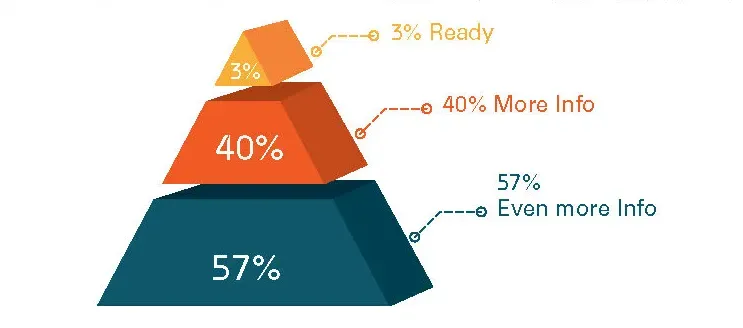
The chart splits prospects into three layers: only 3% at the top are ready to buy; 40% in the middle need more information; and 57% at the base need even more information before they start considering a purchase. In other words, when you promote your offer, only 3% of customers have an immediate need for your service — and fewer than 1% actually buy. To learn how to read a prospect's buying intent, see "Know Your Customer's Temperature and You'll Know How to Sell."
How Do Most Startups Lose Customers?
Picture this:
- Pitching only at first contact: your whole sales cycle focuses on that very first touchpoint → in the end, only 3% have an immediate need, and fewer than 1% act and buy right away.
- No re-marketing: you don't just lose the 97% with no immediate intent to buy — you also lose the 2% who are ready to buy but haven't acted yet, the people most likely to purchase a little later.
- Silence after the sale: among the 1% who did buy, you never follow up with new products, services or fresh ways to use what they bought → you never turn them into repeat, reordering customers.
This is how most startups operate — and it's the fatal reason so many of them fail within two years.
What Successful Businesses Do: Nurture the 97% and Build a Value Ladder
Successful businesses focus on nurturing the prospects beyond that 3%. They build a value ladder, continually delivering value to existing customers and making them feel valued — so a small customer who first spent $100 gradually grows into a lifetime High Value Customer spending $1,000, $2,000, even $5,000 or more. Related reading: "4 Keys to Guiding Customers Up the Value Ladder."
Why Contact Customers 5 or More Times?
Take a look at the statistics below and you'll see how much repeated contact matters to your sales:
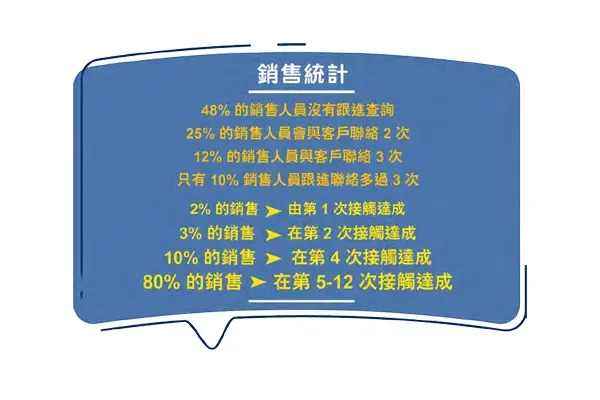
Source: attributed in the original to the National Sales Executive Association. Note that these figures have circulated in sales circles for years and the original research has never been verified, so treat them as a directional reminder rather than a precise benchmark.
The takeaway: you need to stay in touch with a customer at least five times before your business sees results.
How Can Small Businesses Keep Following Up?
Of course, if you have enough salespeople, you can reach customers through many channels. But small and medium-sized businesses don't have the resources to follow up with every customer one by one by phone, LINE or WhatsApp (LINE is the go-to in Taiwan, WhatsApp in Hong Kong).
An automated funnel is the sales tool that delivers information to customers in an orderly way — scaling your value delivery while accurately recording user preferences and building a full picture of each customer's digital footprint. That's the cornerstone of precise re-marketing. Do all of this well and you won't just win conversions — you'll walk each customer step by step to the top of the value ladder, and your sales are sure to grow!
To see how leads, tags and follow-up fit into one flow, explore marketing funnels and omnichannel messaging automation.
Related articles
- Why Personal Branding Matters So Much in the Gig Economy
- How to Choose Marketing Automation Tools for a Small Business
- [Must Read 2026] LINE Official Account Price Hike: Cut Costs