
Funnel Marketing
Abandoned Cart Remarketing: How to Win Back Lost Orders
Published Updated
Abandoned cart remarketing brings back shoppers who never checked out. Learn why carts are abandoned, how to fix checkout, and how to build a reminder sequence.
Contents
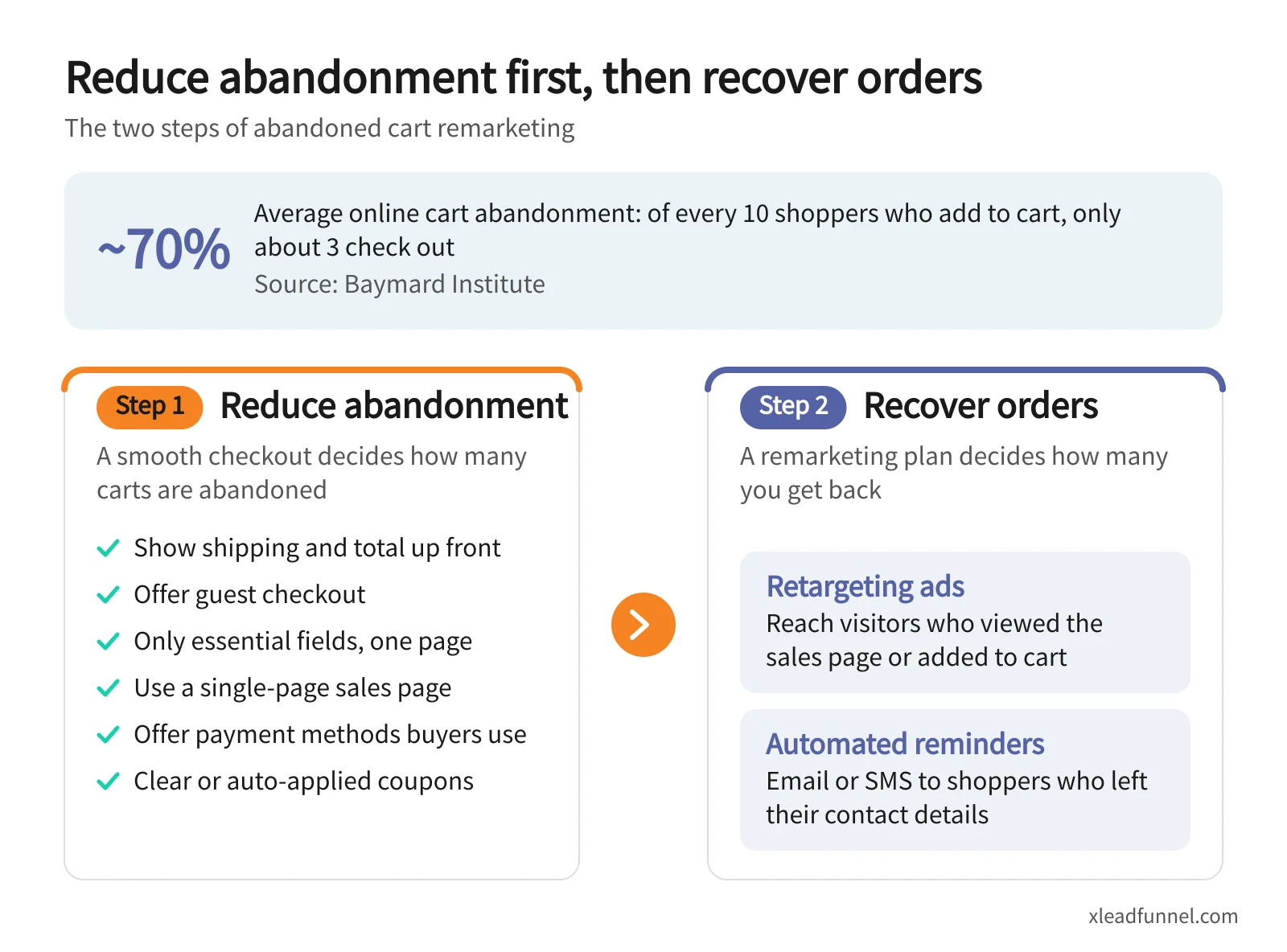
Abandoned cart remarketing means re-engaging shoppers who added products to their cart but never checked out, using retargeting ads and automated reminders by email or SMS to bring those orders back. The order of operations matters: first reduce how many carts get abandoned, then use a staged reminder sequence to win back the shoppers who are still on the fence.
Why Do Shoppers Abandon Their Carts?
Cart abandonment is the constant headache of online selling. You've used a compelling offer to bring a prospect in, they've put something in their cart, and then they leave without paying. According to Baymard Institute, which aggregates dozens of studies, the average documented online cart abandonment rate sits at roughly 70% — so for every 10 shoppers who add an item, only about 3 complete the purchase.
Baymard's user research also shows that, apart from people who were "just browsing," the most common reasons for abandoning a cart are:
- Extra costs were too high — shipping, taxes or fees appear only at the final step
- The site required an account — the shopper wanted to buy once, not sign up
- Checkout was too long or complicated — too many fields, too many pages
- They didn't trust the site with their credit card details
- Delivery was too slow, or the returns policy was unclear
- Not enough payment options, or the site was slow or buggy
These reasons fall into two buckets: how smooth your checkout is, and whether you have a remarketing plan once shoppers leave. The first decides how many carts are abandoned; the second decides how many you get back.
Step 1: Reduce Abandonment With a Checkout Checklist
Winning back an order always costs more than letting the shopper finish in the first place. Before you spend on remarketing, work through this list:
The single-page sales approach deserves special attention: with only one goal on the page, shoppers aren't distracted by other options and can focus on a simple ordering process. To see why single-goal pages convert better, read "Landing Pages — How They Differ From Websites and Shopping Carts."
Step 2: Choose Your Remarketing Channels
The two work best together: ads keep your brand in front of the shopper, while reminders arrive at the moment they're most likely to return, with a direct link back to checkout.
Tip: Put the email or phone field first in your checkout form. Even if the shopper leaves halfway, you can still follow up. Related reading: "The Best Starting Point for Re-marketing — Build Your Customer List."
Step 3: Build a Three-Stage Cart Reminder Sequence
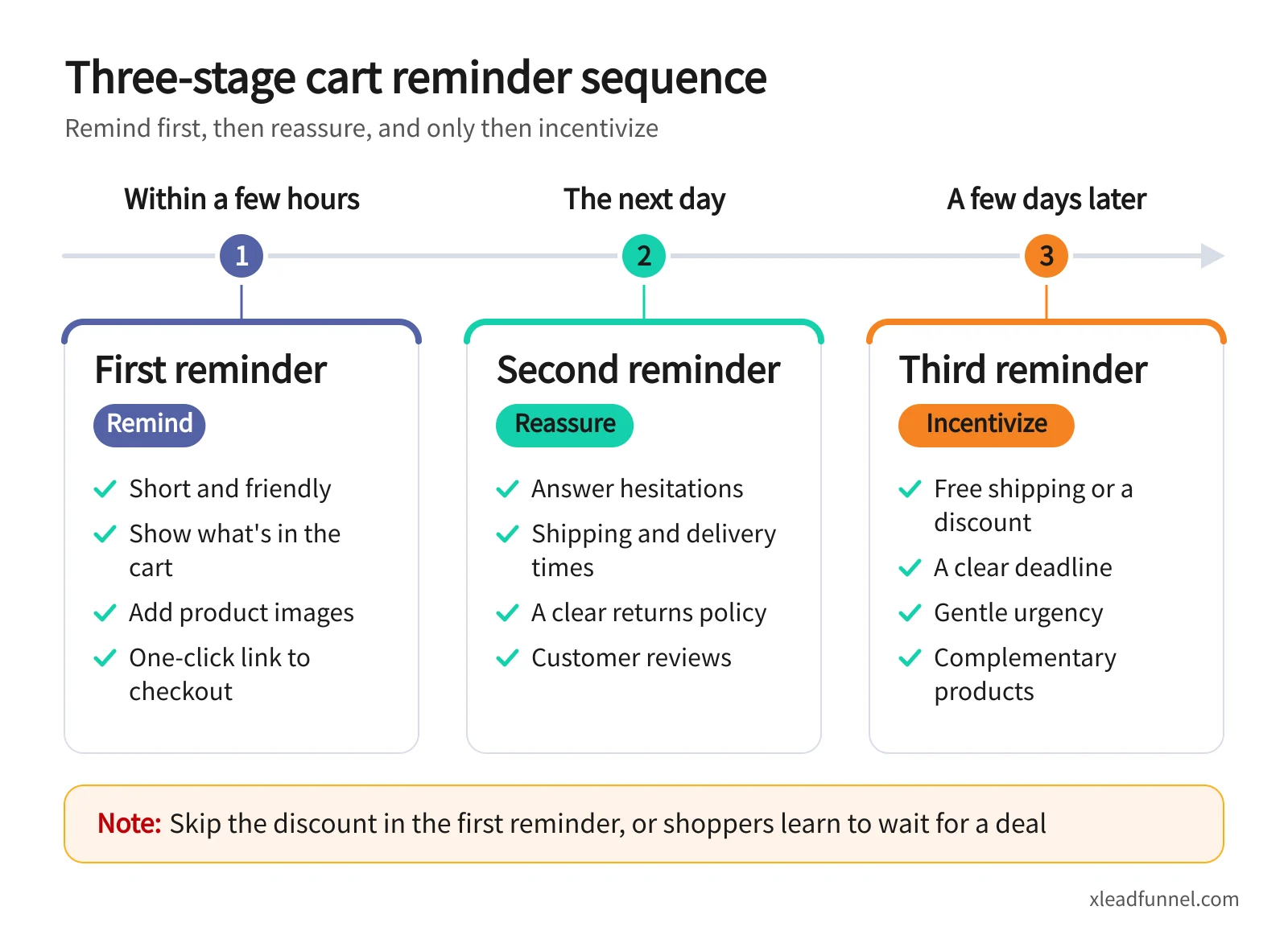
- First reminder (within a few hours): Keep it short and friendly. Show what's still in the cart, with product images and a one-click link back to checkout. Many shoppers were simply interrupted or forgot.
- Second reminder (the next day): Address likely hesitations — shipping costs, delivery times, the returns policy — or add reviews from other customers. By now they may have compared other brands, and clear information helps them decide.
- Third reminder (a few days later): Only now consider a time-limited incentive such as free shipping or a small discount, with a clear deadline to create gentle urgency. You can also suggest complementary products.
Avoid offering a discount in the very first reminder, or you'll teach customers to leave items in the cart and wait for a deal. Adjust the exact timing to your price point and how long your customers usually take to decide.
How to Write Reminders That Work
- Make the subject line specific: "Your cart is still waiting for you" gets opened more readily than a generic promotion
- Use one call to action: a single button back to checkout, with no competing links
- Show the products and the total: help the shopper remember what they picked
- Match the message to the customer: reassure new customers about trust and guarantees; give regulars an exclusive offer
Beyond Recovering Orders
Abandoned cart remarketing isn't only about chasing down one order — it's about lifting your overall conversion rate. Reducing abandonment so more people complete their first purchase smoothly is the real fix. And in the long run, every shopper who buys, or even just leaves their contact details, joins your customer database. Even if you lead with a low-margin entry product, customers remain your business's greatest asset: what you really earn is their future spending.
Abandoned Cart Remarketing With X Lead
- One-page mini store: The Mini Store form puts product details, the order form, add-on suggestions and coupons on a single page, so customers buy without jumping between pages, and every order and buyer profile lands in your back office automatically.
- Tracking codes for retargeting: Pages can carry GA and FB Pixel tracking codes, so you can retarget visitors who viewed your sales page.
- Automatic follow-up by purchase status: Contacts are tagged automatically by source, form answers, click behaviour and purchase status, and those tags trigger the matching email, SMS or reminder — so shoppers who haven't completed a purchase keep getting followed up. Learn more about automated messaging.
Ready to hand abandoned-cart follow-up to a system? Sign up free and start with a single one-page sales page.
FAQ
How is abandoned cart remarketing different from general remarketing?
General remarketing targets everyone who has visited your site. Abandoned cart remarketing focuses on the people who already added products to their cart — your highest-intent visitors — so the message can be far more specific and remind them of the exact order they left behind.
When should I send abandoned cart reminders?
A common pattern is three messages: the first within a few hours, a second the next day to answer concerns, and a third a few days later with a time-limited incentive if needed. Tune the timing to your price point and your customers' decision cycle.
Do I have to offer a discount to recover abandoned carts?
No. Many shoppers simply forgot or got interrupted, and a plain reminder is enough. Save discounts for the final reminder and give them an expiry date.
Can I run cart remarketing without a full e-commerce website?
Yes. As long as your sales page can hold tracking codes and your order flow captures contact details, you can run retargeting ads and send reminders. A one-page sales page with an order form is enough to get started.
Related articles
- Event Registration Form: Setup, Reminders & Check-in Guide
- Online Booking Form: What to Collect & How to Cut No-Shows
- From funnel form to follow-up: how multi-channel drip sequences actually work