
Founder's Mindset
The Best Starting Point for Re-marketing — Build Your Customer List
Published
Why re-marketing starts with your own customer list: email ROI figures from McKinsey, Experian and the DMA, why an owned list beats social reach, and how to turn social traffic into contacts.
Contents
Building your own customer list is the best starting point for re-marketing. Ads buy you a single moment of attention, but once a visitor leaves an email address or mobile number, you can keep talking to them at almost no cost — turning one-off traffic into an asset you own.
Here's a fun fact: most startups rely on email to tell customers about the new services and products they're about to launch.
And here's another: there are plenty of cases where an author who emails existing customers about a new book finds that 30% of the orders come from those existing customers.
Why isn't buying ads enough?
Buying ads simply means paying upfront just to earn a baseline amount of website traffic.
In Why 90% of Startups Don't Survive Two Years, we pointed out that only 3% of your prospects have an immediate need for your product. Even if you also run a discount with a price that's hard to resist, you might squeeze out only a slightly better return.
In the real world, you may catch the perfect moment and sell something everyone is excited about. Inside a sales-funnel model, breaking even — say your ads cost HK$50 a day and the front-end page earns HK$50 back — means you're actually doing pretty well.
But if you go one step further, capture customers' email addresses and convert them into buyers, that's a whole different story.
How does a customer list make re-marketing almost free?
Once you have those email addresses, the long-term communication that follows is the nurturing process. Each email costs very little — around HK$0.02 at the time of writing, hardly a cost at all — so it's easy to keep delivering value at close to zero cost. If a single marketing email brings in an order, you can imagine how strong the return is. With your own list in place, you have an excellent chance of getting large numbers of loyal customers interested enough to buy.
We call the process of continually sending high-quality emails and moving customers step by step to bigger purchases the "value ladder." To see why the value ladder matters so much to your business, read the same article linked above.
How high is the ROI of email marketing?
Think we're exaggerating? Here are some widely cited figures — judge for yourself:
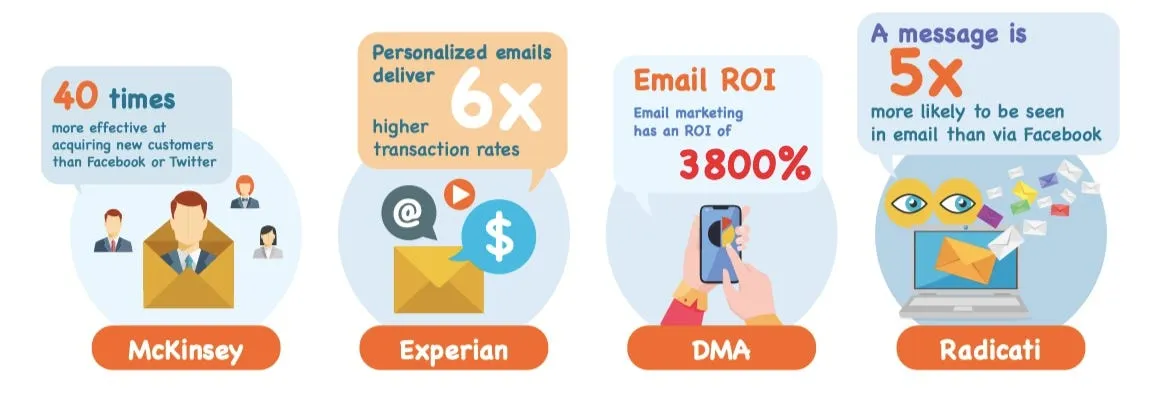
- Customer acquisition: A McKinsey study found email is nearly 40 times more effective at acquiring new customers than Facebook and Twitter combined.
- Personalization: Email can be personalized, so customers feel your brand genuinely looks after them and treats them as someone special. Experian found personalized emails generate, on average, six times higher transaction rates than non-personalized ones.
- Reach: At the time of writing, a Facebook post typically reached fewer than 5% of followers — with 10,000 followers, fewer than 500 people might see it. Email goes directly to every customer in your database; the Radicati figure in the infographic says a message is five times more likely to be seen in email than on Facebook.
- Return on investment: The UK DMA estimates the average ROI of email marketing at around 3,800% — roughly 38 back for every 1 spent.
Why is an owned list your brand's real asset?
Beyond the ROI, there's another key reason to build your own list: you're building an asset of your own!
Your email list belongs to you, so you never have to worry about a platform suddenly changing its rules or algorithm and wrecking your marketing strategy. Compared with other paid media there are far fewer restrictions, and you can send personalized, tailor-made messages to your customers.
Social platforms like Facebook and YouTube, by contrast, keep changing their ad algorithms, disrupting the strategies and ad budgets you prepared in advance — and, as noted above, their reach is low. Think about it: even if one of your videos gets a million views, how many of those viewers are in your own database? Can you re-market to them? Do you know who they are, or what they want?
How do you turn social traffic into a customer list?
We always say social media is great for attracting traffic, but you still need a plan for getting visitors to leave their contact details, join your database and become your asset. Smart brands usually offer an irresistible incentive in exchange for signing up.
With the email addresses and mobile numbers in your database, you can build your own communication channels and start personalized conversations with customers. Email and SMS aren't the newest technology, but they remain among the most reliable channels for driving sales.
In practice, start with three things:
- Trade a clear incentive for contact details — a first-order offer or free trial, for example, collected through a coupon redemption form.
- Sort the list by source and interest, so you can send different people personalized content later.
- Follow up on a steady rhythm with useful email and SMS content, not only when there's a sale. For pacing ideas, see 5 drip follow-up sequence templates, and schedule the sends with multichannel messaging automation.
Related articles
- Why Personal Branding Matters So Much in the Gig Economy
- How to Choose Marketing Automation Tools for a Small Business
- [Must Read 2026] LINE Official Account Price Hike: Cut Costs