
Founder's Mindset
Beyond Linktree: Explain Who You Are on One Page, and Keep the Client
Published
Why is Linktree so popular, and where does it top out? With 70M+ users it sends people away without capturing a lead. This post uses Linktree's own and third-party figures to show the ceiling, then introduces a Taiwan-fit alternative: a LINE Name Card people save with one scan plus a 1 PAGE Profile that explains who you are, with leads in your own database.
Contents
Linktree solves "too many links, only one slot". It does not solve "what happens after someone looks". For freelancers, consultants, realtors, insurance and financial advisors, and anyone who closes on trust, a personal brand needs more than a list of links. It needs a place where people can understand you, save you, and find you again later. This post is honest about why Linktree is popular, then shows where it tops out, and ends with an approach that fits how business actually happens in Taiwan: a LINE Name Card plus a 1 PAGE Profile.
Why everyone likes Linktree
Linktree, founded in Australia in 2016, is a "link in bio" tool: it gathers every platform, portfolio and store you have into one page of links, and that single link goes in your Instagram bio. It took off because Instagram allowed only one bio link for years. Not until April 2023 did Meta allow up to five, which Mark Zuckerberg called "probably one of the most requested features" (TechCrunch).
The scale proves the need is real:
- Users grew from 24 million in March 2022 to 50 million in May 2024 and past 70 million by April 2025 (TechCrunch, TechCrunch).
- Its 2022 funding round valued the company at US$1.3 billion (TechCrunch).
- Linktree reports 1.3 billion clicks a month, and Instagram alone sent roughly 11 billion page views to Linktree pages between May 2025 and April 2026 (Linktree report, Linktree blog).
- In an analysis of 100 million Instagram accounts, 31 million used a link-in-bio tool and Linktree held close to 80% of them (influencers.club, November 2024).
The appeal is simple: free, live in a minute, no design skills, one link for everything. Those strengths are real, and they make Linktree a fair starting point.
Where Linktree tops out: a signpost, not a front door
The catch is that Linktree is designed to send people somewhere else. For creators that is fine, because followers already know them. For professionals who sell on trust, that is exactly the gap.
Only people who already want you will click
Two numbers get mixed up. Linktree says 80% to 95% of people who reach a Linktree page click a link. Industry benchmarks put the share of Instagram profile visitors who tap the bio link at only about 2% to 5%. A link hub works on people who already intend to find you; it does not turn a new acquaintance into one.
They look, they leave, nothing stays
A list of links does not tell anyone what you specialise in, who you serve, what you have done, or how to start. The visitor taps a link, lands on Instagram or your site, and leaves. You do not know who they were, where they came from, or what interested them.
The list is not yours
Linktree's free plan cannot collect emails or phone numbers and cannot remove the Linktree logo. After the November 2025 price change, Starter is US$8 a month, Pro US$15 and Premium US$35, and the free plan takes a 12% cut of digital product sales (Talkspresso summary; check the official pricing page for current figures). The traffic and trust you build accrue to the linktr.ee domain, not to your own name.
Platform risk has actually happened
In March 2020 Linktree confirmed on its social account that Instagram had been blocking linktr.ee links after mistakenly flagging them as spam (Linktree post); a similar incident was reported in 2018. When your front door sits on someone else's domain, you do not decide when it closes.
First impressions are decided by design
Stanford's Persuasive Technology Lab surveyed 2,684 people and found that "design look" was the most frequently mentioned factor when judging a website's credibility, appearing in 46.1% of comments and 54.6% for finance sites (Fogg et al., 2002). Another study showed people form a visual impression of a web page within 50 milliseconds (Lindgaard et al., 2006). A link list that looks like tens of millions of others rarely earns a professional extra credit.
The Taiwan context: your clients are on LINE, not in your bio
Linktree serves the "fans come to you" scenario. In Taiwan, professional business mostly happens through exchanged name cards, group referrals and LINE conversations.
- LINE Taiwan reports more than 21 million monthly active users, and 88% of people aged 12 to 65 used LINE in the past seven days (LINE Taiwan Sales Kit, October 2025).
- Taiwan now has more than 3.4 million LINE Official Accounts (LINE for Business SME conference, September 2026).
- A 104 Job Bank and Uber white paper found 33% of respondents had done some form of freelance work in the past year, with 60% of them aged 35 to 44 (104, June 2025).
What these people need is not social traffic. It is the ability, after a meeting or a chat, for the other person to decide within a minute whether to work with them. A front door inside the app your clients open every day gets seen far more than a link hidden in a bio. (If your market is Hong Kong, the same logic applies with WhatsApp, where monthly usage among internet users is about 75% versus 22% for LINE.)
A better fit: LINE Name Card plus 1 PAGE Profile
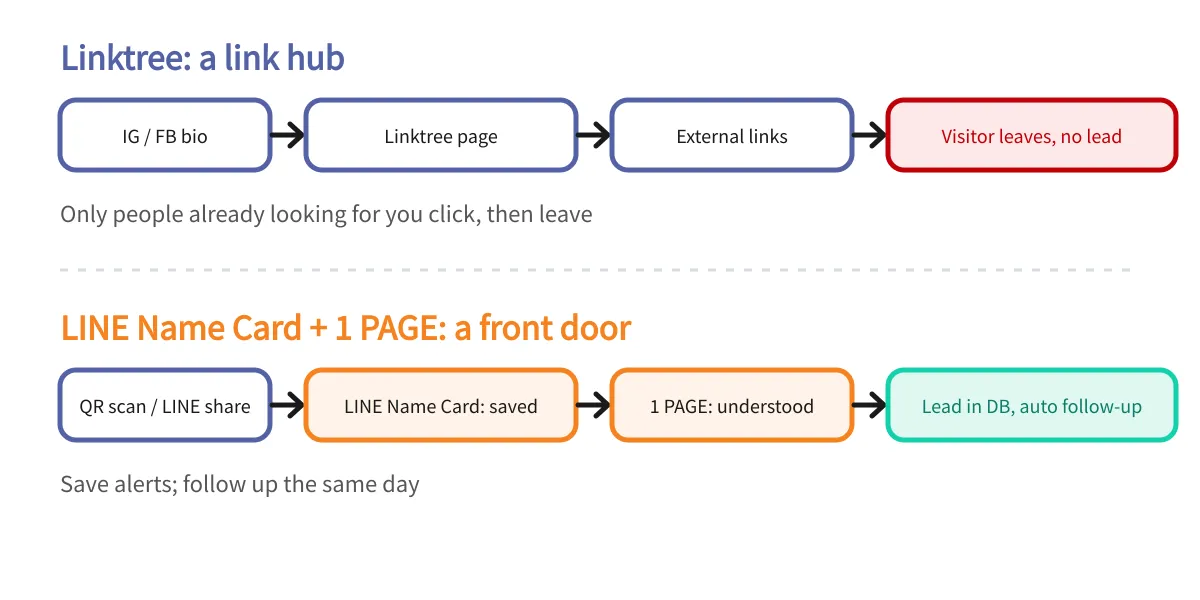
The diagram compares the two paths. With Linktree, someone sees you on Instagram or Facebook, opens your Linktree page, taps an external link and leaves; you hold no lead. With a LINE Name Card and 1 PAGE, someone scans your QR code or receives your card in LINE, saves it with one scan, opens your 1 PAGE to understand who you are, and their contact or booking action lands in your customer database for automatic follow-up.
LINE Name Card: getting saved
The LINE Name Card is an interactive card people save with one scan. They see the full card in LINE and save it without typing or installing an app, and at the same moment they land in your contacts folder. When someone saves you, LINE pushes an instant notice plus a weekly report; shares, savers, sources (QR scan or request) and referral chains are all recorded. Change your title or number and the card updates without reprinting.
1 PAGE Profile: getting understood
The 1 PAGE Profile gathers your intro, services, case studies, credentials, process and contact details into one page. Seven role templates (realtor, insurance planner, financial advisor, car sales, therapist, instructor and general professional) put the right fields in the right order. You can also sign in with your LINE Name Card and let AI research your industry and draft your positioning, services and highlights, then edit text, swap images and drag blocks. Put that one link in your LINE Name Card, Instagram bio and email signature, and you only write your introduction once.
Both feed one customer database
This is what Linktree structurally cannot do. Everyone who saves your card or taps contact or book on your 1 PAGE becomes a lead you can follow up: sorted by time, with source and referrer recorded, auto-tagged as trade show, visit or referral, and followed up by LINE, email or SMS according to those tags. Every view of your card and profile accumulates in a database you own.
Side by side
Cases: how digital cards and one-page fronts bring business
- EisnerAmper (accounting and advisory): after adopting digital business cards, more than 3,000 shares in four months, 800+ qualified leads and about US$400,000 of qualified pipeline, with scan-to-CRM averaging 17 seconds (Popl case study, vendor-reported).
- McKnight International (construction management): the CEO credits digital card exchanges with winning projects worth over US$100 million in each of four new states (Popl case study, vendor-reported).
- Taiwan LINE merchants: among cases highlighted at the LINE for Business conference, fruit shop RE'ME grew monthly revenue 20% and cut customer-service workload 40% after moving customer management into LINE (NewsPie).
To see what a finished one-page profile looks like, open our sample 1 PAGE.
Your checklist for this week
- Write a one-sentence positioning: who you serve, what problem you solve, what result you deliver.
- Create your LINE Name Card and make sure save alerts are on.
- Let AI draft your 1 PAGE from the card, then add two or three public cases or results.
- Put the 1 PAGE link back into your LINE Name Card, Instagram bio and email signature. Keep your Linktree if you like, but make its first link your 1 PAGE.
- Check that contact and booking actions on the 1 PAGE reach your database, and set up one automatic reply.
Linktree is not the wrong tool; it is built for a different kind of person. If your business comes from trust rather than traffic, get saved and understood first, then worry about the other links. Related reading: Why Personal Branding Matters So Much in the Gig Economy.
Related articles
- How to Choose Marketing Automation Tools for a Small Business
- [Must Read 2026] LINE Official Account Price Hike: Cut Costs
- ActiveCampaign Alternatives in Taiwan & HK: LINE & Chinese UI