
Funnel Marketing
What Is a Marketing Funnel? Stages, Types & How to Build One
Published Updated

What is a marketing funnel? A clear definition, the 5 stages with goals and KPIs, marketing vs sales vs purchase funnels, and how small businesses build one.
Contents
A marketing funnel is a model of how a stranger becomes a customer — and then a repeat customer. It breaks the journey into stages such as awareness, interest, consideration, conversion, and loyalty. Fewer people make it through each stage, so your job is to give people at every level exactly the content and call to action they need to move one step further. Put simply, a marketing funnel is the roadmap that turns traffic into revenue.
Why is it called a funnel?
Plenty of people see your ad, fewer leave their contact details, and fewer still end up buying — draw it and you get a shape that's wide at the top and narrow at the bottom. Most people don't buy on first contact: some are comparing prices, some are comparing features, some simply don't need it yet. A funnel earns its keep by meeting each of those hesitations with the right information or incentive at the right moment.
Effective funnels share three traits:
- One goal per step. Each page asks the visitor to do one thing. Think of two restaurants: one offers three set menus, the other a 20-item à la carte list. The first usually gets people ordering faster — fewer choices, quicker decisions.
- A clear call to action at every step. Leave your details, book a consultation, claim an offer, place an order — the button only points to the next step.
- It remembers where each person is. Follow-up depends on what someone actually did, instead of one message for everyone.
That is the biggest difference between a funnel and a regular website: a website is a catalogue you browse; a funnel is built to convert, so the path is deliberately simple. Related reading: Landing Pages — How They Differ From Websites and Shopping Carts.
The 5 stages of a marketing funnel
The classic model is AIDA — Attention, Interest, Desire, Action — attributed to advertising pioneer E. St. Elmo Lewis. Modern funnels extend past the sale, because keeping and growing existing customers is often more efficient than constantly finding new ones. Here is the five-stage version most teams use today:
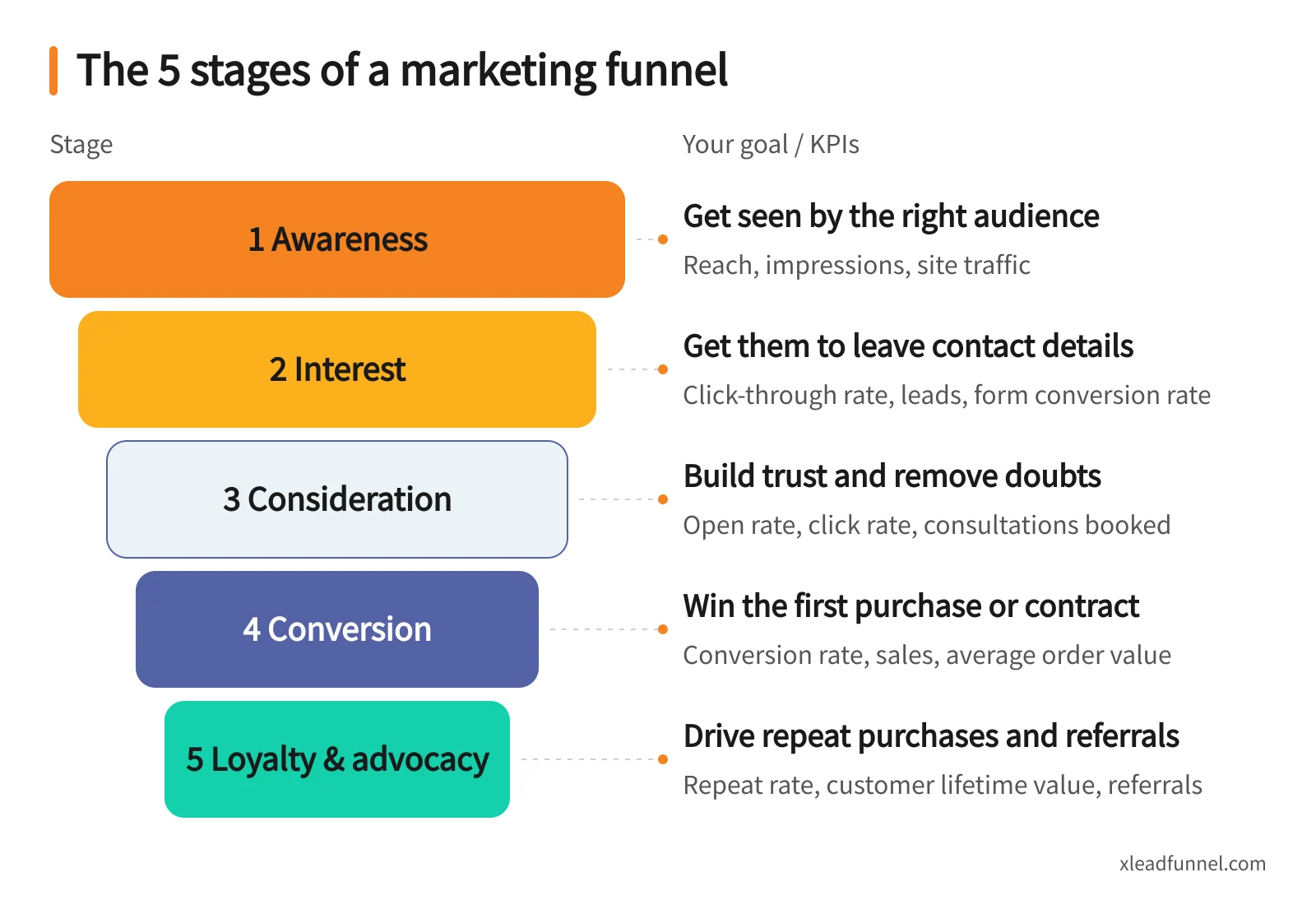
You may also see TOFU, MOFU and BOFU — top, middle and bottom of funnel. Different labels, same idea: each level solves a different problem, so it needs different content and different metrics.
Why extend the funnel past the sale?
A sale isn't the finish line. Keep delivering value at the right moments and customers buy more recently, more often and spend more — the Recency, Frequency and Monetary dimensions of RFM analysis. Guiding people toward higher-value offers over time is the "value ladder"; see 4 Keys to Guiding Customers Up the Value Ladder.
Marketing funnel vs sales funnel vs purchase funnel
All three describe the same customer journey. They differ in whose point of view they take and which part of the journey they cover. A marketing funnel is about attracting and nurturing prospects; a sales funnel is about turning qualified leads into orders; a purchase funnel describes how the buyer makes a decision.
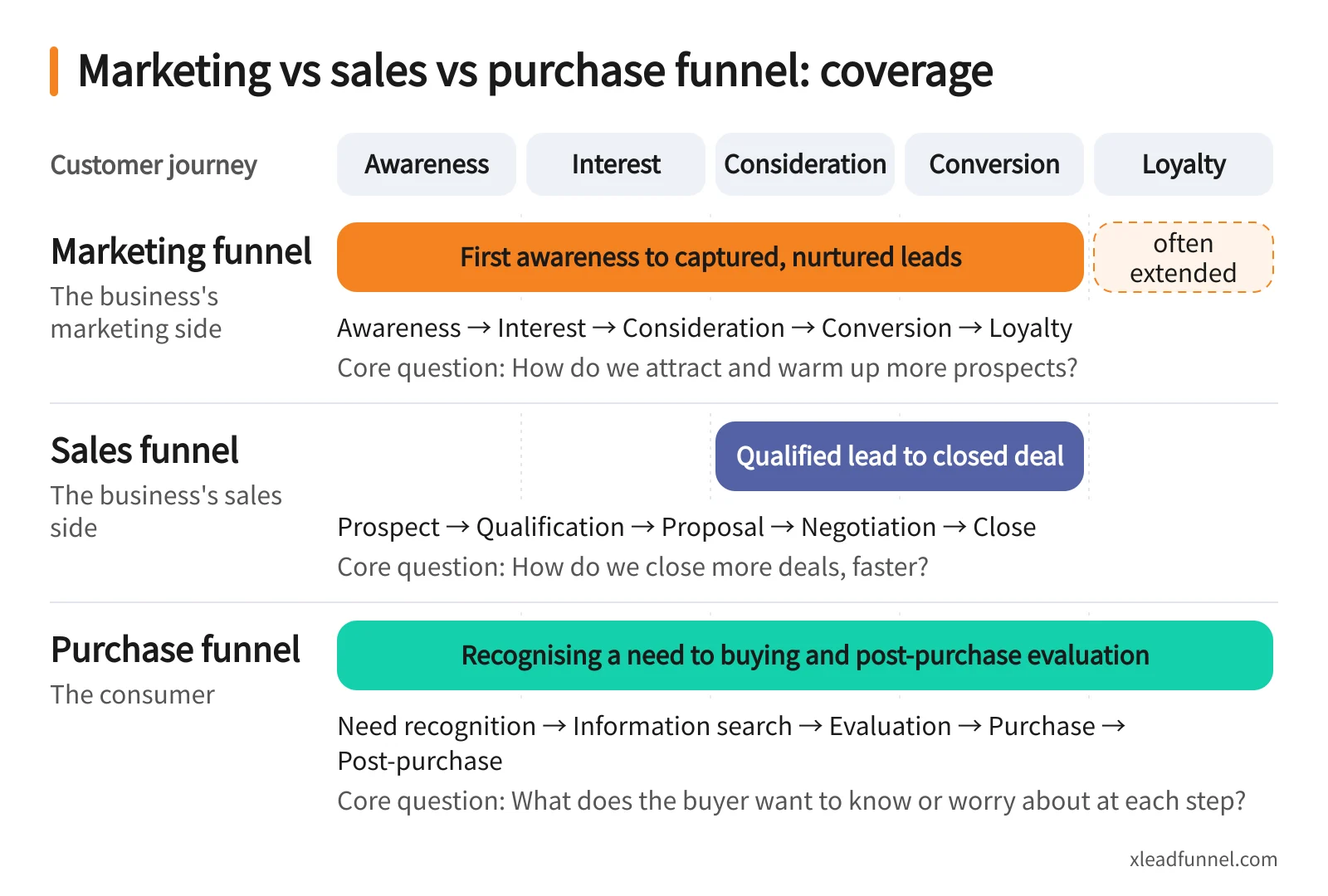
Small businesses and solopreneurs rarely have separate marketing and sales teams, so there is no need to split hairs: use the purchase funnel to understand objections, the marketing funnel to plan content and follow-up, and the sales funnel to track deals. Together they form one conversion path.
A "digital marketing funnel" is the same model run through online channels and data: social, ads and search bring people in, forms capture leads, and email, SMS or messaging apps follow up automatically. Its biggest advantage is that every step is measurable — you can see exactly where people drop off and fix that first.
How to build a marketing funnel: 6 steps for small businesses
- Define your audience and one conversion goal. Answer "who should do what?" — for example, "busy professionals book one free consultation." One goal keeps the funnel focused.
- Create a reason to opt in. Why should anyone leave their details? An ebook, a trial price, a free talk or a time-limited offer — as long as it's closely tied to what you sell.
- Capture leads with a form. Ask at the moment interest peaks, and keep fields to what you genuinely need for follow-up.
- Automate the follow-up. Send a welcome message right away, segment by interest, then deliver useful content on a steady rhythm — not just promotions.
- Give the final nudge. Once people know you, a time-limited offer or a clear next step makes the decision easier.
- Measure conversion at every stage. Fix the level where most people drop off, rather than only watching total sales.
Running a one-person business? Start with a single funnel — say, social post → free consultation booking form → automatic confirmation and reminder → post-consultation follow-up. Once it runs smoothly, add a second.
5 common funnel mistakes
- Buying traffic with nowhere to capture leads. Visitors who leave without contact details are gone for good.
- Too many options on one page. Unclear messages and competing buttons mean people do nothing.
- Collecting leads and then sitting on them. Many people don't buy not because they don't want it, but because nobody followed up a second time.
- Sending everyone the same message. A brand-new lead and a long-time customer need very different content.
- Stopping once the sale is made. Ignore retention and referrals, and you start from zero every month.
How X Lead Funnel supports the whole funnel
X Lead Funnel frames the funnel as four stops — acquisition, retention, nurturing and advocacy — powered by two product lines:
No code is needed, and you can draft form content with an AI prompt. Solopreneurs can start with X Lead for solopreneurs, teams with X Lead for business. There is a free plan, so you can sign up free and build your first funnel today.
FAQ
What is a marketing funnel, in one sentence?
A marketing funnel is a model that guides strangers through awareness, interest, consideration and conversion until they become repeat customers and advocates — a systematic way to turn traffic into revenue.
What's the difference between a marketing funnel and a sales funnel?
The marketing funnel covers the front end — attracting prospects, capturing leads and building intent. The sales funnel covers the back end — turning qualified leads into orders. They connect end to end, and small businesses usually run them as one.
What is a purchase funnel?
A purchase funnel describes the buying decision from the customer's side: recognising a need, searching for information, evaluating options, purchasing and post-purchase behaviour. It tells you what each level of your funnel should address.
Do small businesses and solopreneurs need a marketing funnel?
Yes — arguably more than anyone. With limited resources, you can't afford to let hard-won traffic slip away. One lead-capture form plus an automated follow-up sequence is already a working funnel.
Do I need to code or buy lots of tools to build one?
No. With X Lead Funnel, forms start from templates, leads are stored automatically and connect straight to messaging automation — capture and follow-up happen in one platform, and you can start on the free plan.
Related articles
- Event Registration Form: Setup, Reminders & Check-in Guide
- Online Booking Form: What to Collect & How to Cut No-Shows
- From funnel form to follow-up: how multi-channel drip sequences actually work